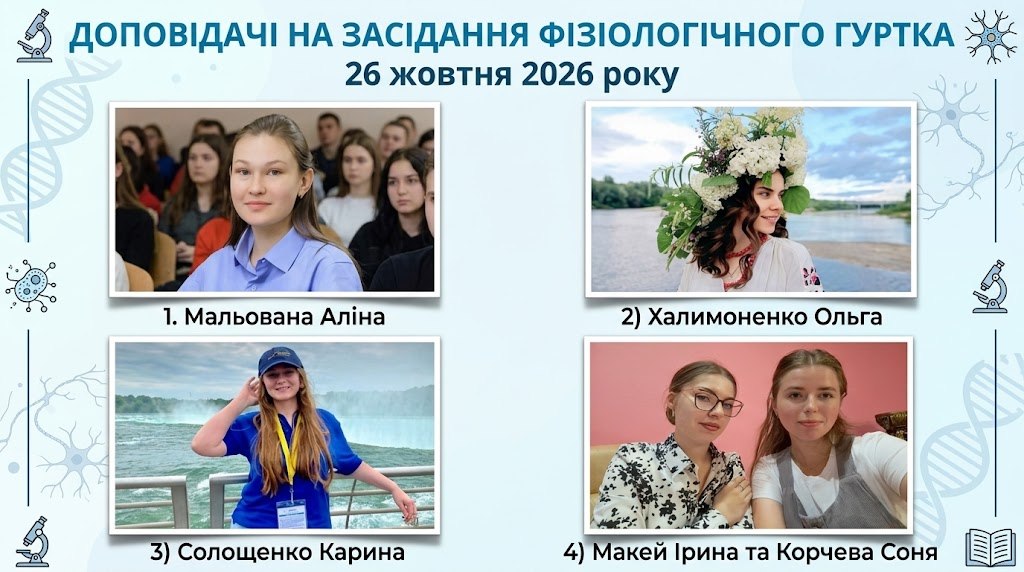
The Nobel Prize is one of the world’s most prestigious international awards, presented annually in recognition of outstanding scientific discoveries, revolutionary inventions, and significant contributions to culture and the development of society. Every October, the Department of Physiology and Pathophysiology holds a meeting of its student research group dedicated to this important event.
On 26 October 2026, the group held a meeting featuring presentations on the 2026 Nobel Prize in Physiology or Medicine. The Nobel Assembly announced Karl Deisseroth, Peter Hegemann and Georg Nagel as this year’s laureates for their groundbreaking discoveries concerning light-gated ion channels and optogenetics.
The first presentation was delivered by Alina Maloviana (group SM-501), who spoke on the topic “The Nobel Peace Center: Oslo, Norway.” She shared her personal experience of visiting the Nobel Peace Center. The presentation also highlighted how advances in science—from the discovery of microRNA and the fine-tuning of immune responses through regulatory T cells to the optical control of neurons using optogenetics—offer new opportunities to address diseases that were considered incurable just a few decades ago.
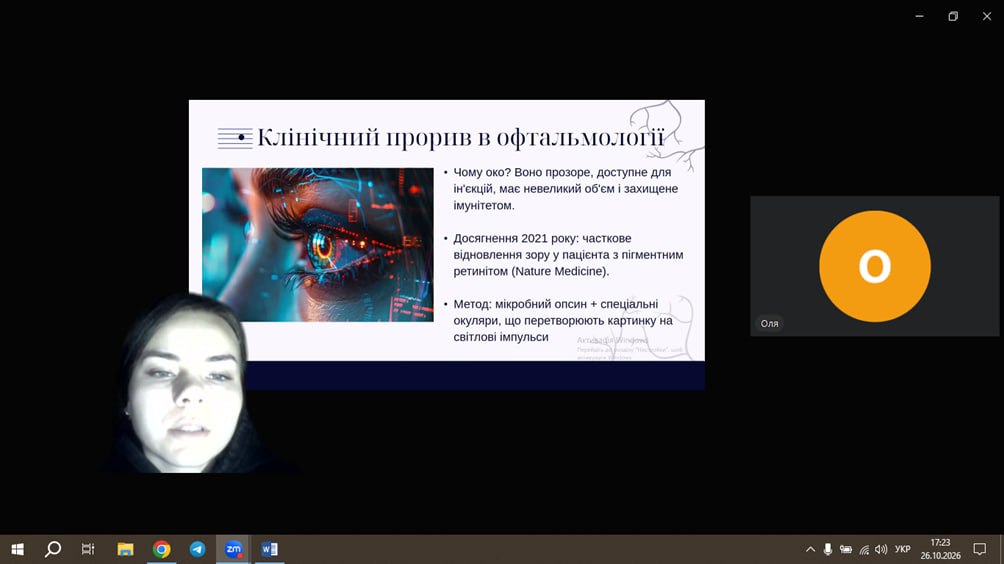
Olha Khalymonenko, a fourth-year student (group MC.m-310), presented “Optogenetics as a Method for Studying the Human Brain.” Her presentation outlined the fundamental principles of this biotechnological method, which uses light to control cellular activity. Optogenetic control of nerve cell activity has led to numerous discoveries, deepening our understanding of the functions of neural circuits in the brain. It also opens up new possibilities for developing therapeutic approaches for Parkinson’s disease, epilepsy, severe depression and the restoration of lost vision.
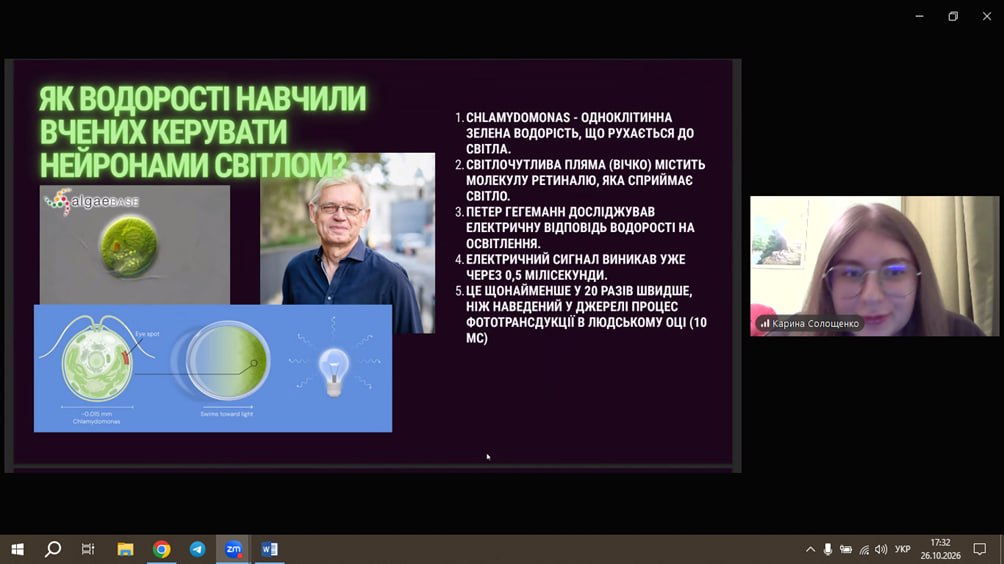
Karina Soloshchenko, a second-year student (group MC-502), delivered a presentation entitled “Light as a Switch for Neurons: Channelrhodopsin.” To understand how memory, emotions and behaviour work, it is not enough to know which brain regions are responsible for particular functions. It is also essential to identify the specific nerve cells involved and understand how their activity influences brain function.
A decisive step towards achieving this goal was made by Peter Hegemann and Georg Nagel, who studied light-sensitive proteins in single-celled green algae. Karl Deisseroth subsequently built on these discoveries to control neuronal activity using light. This led to the development of optogenetics, a method that enables researchers to activate or inhibit specific nerve cells using light.
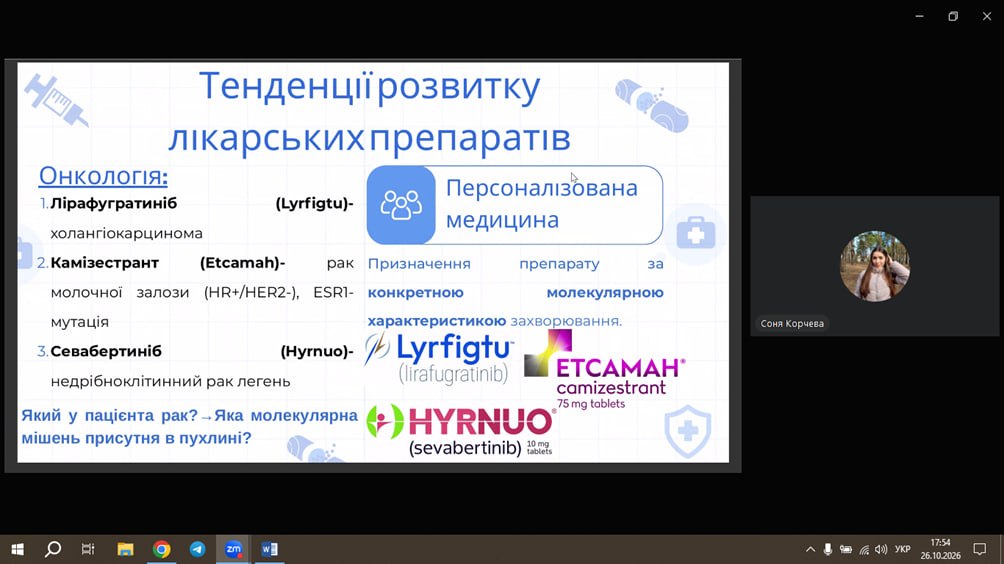
Sixth-year students Iryna Makei and Sonia Korcheva presented “New Medicines and Vaccines: Advances in Modern Medicine in 2026.” Their presentation explored major developments in pharmacotherapy and emerging trends in drug development.
One of the key trends highlighted was the shift from symptomatic treatment towards pathogenetically targeted, molecularly guided and personalised therapies. As of 28 September 2026, the US Food and Drug Administration (FDA) had approved 45 novel drugs during the year.
The presentation covered advances in obesity treatment, new medicines for diabetes and kidney diseases, novel anti-infective drugs, innovations in haematology, the development of mRNA vaccines against influenza, and HPV vaccination in Ukraine.
The participants’ presentations are now available on the Department’s YouTube channel:
Alina Maloviana: https://youtu.be/JgQtQ404hsc
Olha Khalymonenko: https://youtu.be/d3TTqY7wvtk
Karina Soloshchenko: https://youtu.be/ieNtnXCnxqo
Iryna Makei and Sonia Korcheva: https://youtu.be/U-GGox5SPX4