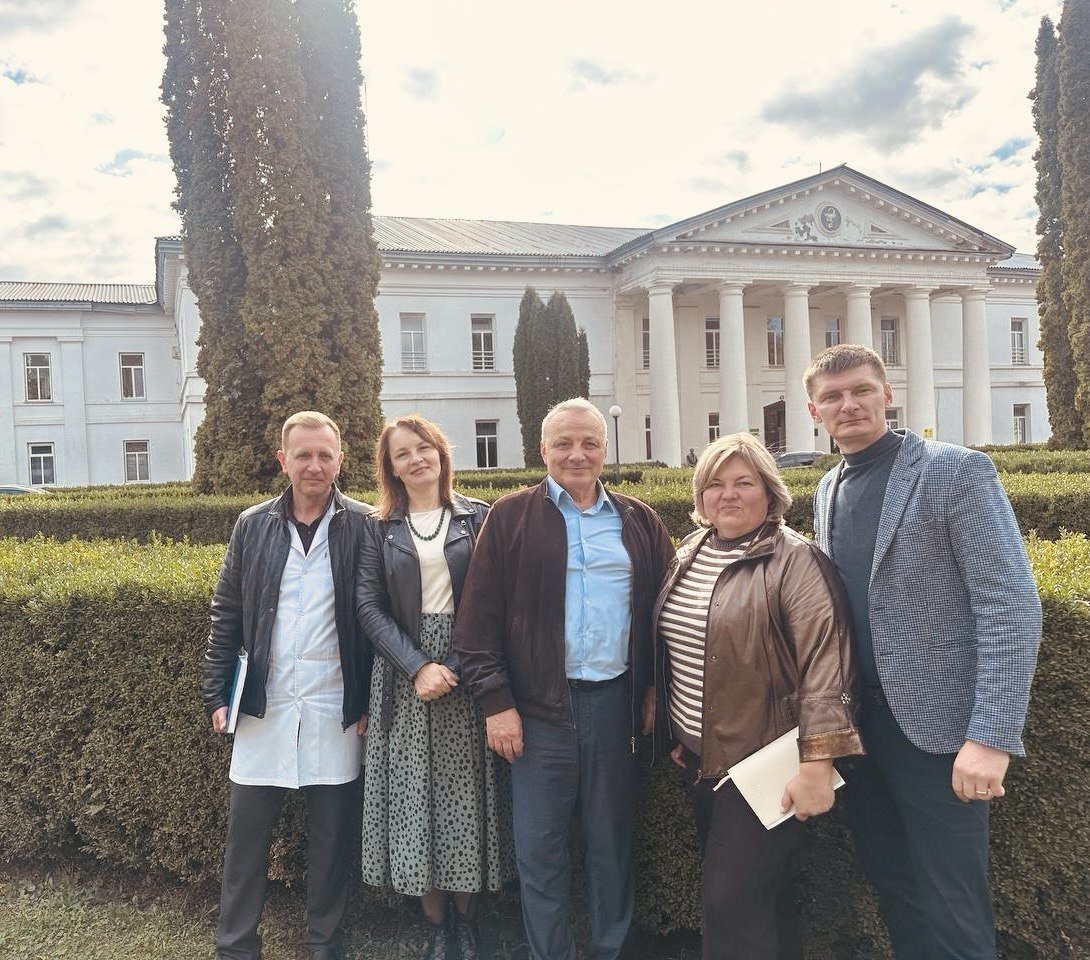
On 7 October 2026, a working meeting was held between representatives of Sumy State University and Sumy Regional Clinical Specialised Hospital as part of a research project funded by the Ministry of Education and Science of Ukraine entitled “Medical and Social Rationale for Optimising the Model of Medical Care for Patients with Post-Traumatic Stress Disorder, Taking into Account Molecular Genetic Risk Factors.”
The meeting was attended by Tetiana Holovko, Director of Sumy Regional Clinical Specialised Hospital; Dmytro Lisovyk, Medical Director; and representatives of Sumy State University: Vladyslav Smiyanov, Head of the Department of Public Health, Doctor of Medical Sciences and Professor; Viktoriia Harbuzova, Head of the Department of Physiology and Pathophysiology, Doctor of Biological Sciences and Professor; and Oleksandr Oleshko, Associate Professor at the Department of Public Health, Candidate of Medical Sciences, and Head of the Regional Centre “ECOMEDCHEM,” where the research project is being carried out.
The main focus of the discussion was the organisation and optimisation of medical care for patients with post-traumatic stress disorder (PTSD), as well as opportunities to improve approaches to its diagnosis, prevention and treatment.
Participants discussed current issues concerning cooperation between the healthcare institution and the university’s research community, organisational aspects of implementing the study, and opportunities to translate its findings into practical improvements in the delivery of medical care.
Particular attention was paid to molecular genetic risk factors associated with the development of PTSD and the potential for incorporating these factors into a modern model of medical care. Integrating clinical, medical and social, and molecular genetic approaches offers opportunities for a more personalised approach to patient care and for improving the effectiveness of preventive and therapeutic interventions.
During the meeting, participants also planned further collaborative activities within the research project, identified the main priorities for the next stages of the study, discussed organisational matters, and outlined subsequent steps for collecting and analysing the required data.
Such working meetings are an important part of conducting scientific research and help strengthen practical cooperation between researchers and healthcare professionals. They also support the translation of research findings into clinical practice and contribute to the continued development of evidence-based approaches to healthcare.